Simon Nkoli
Artwork By:
Arantza Pena Popo
Words By:
Jennifer Coulson
Scroll Down

About
Have you ever thought about what it really means to make a difference – and what that even looks like? Let me paint you a picture. The year is 1984, and you are arrested while attending a funeral, all under the charge of “illegal gatherings.” Once imprisoned, you are abused and held in isolation without charge for nearly nine months – but you refuse to back down and continue to fight even harder for the rights of those around you.
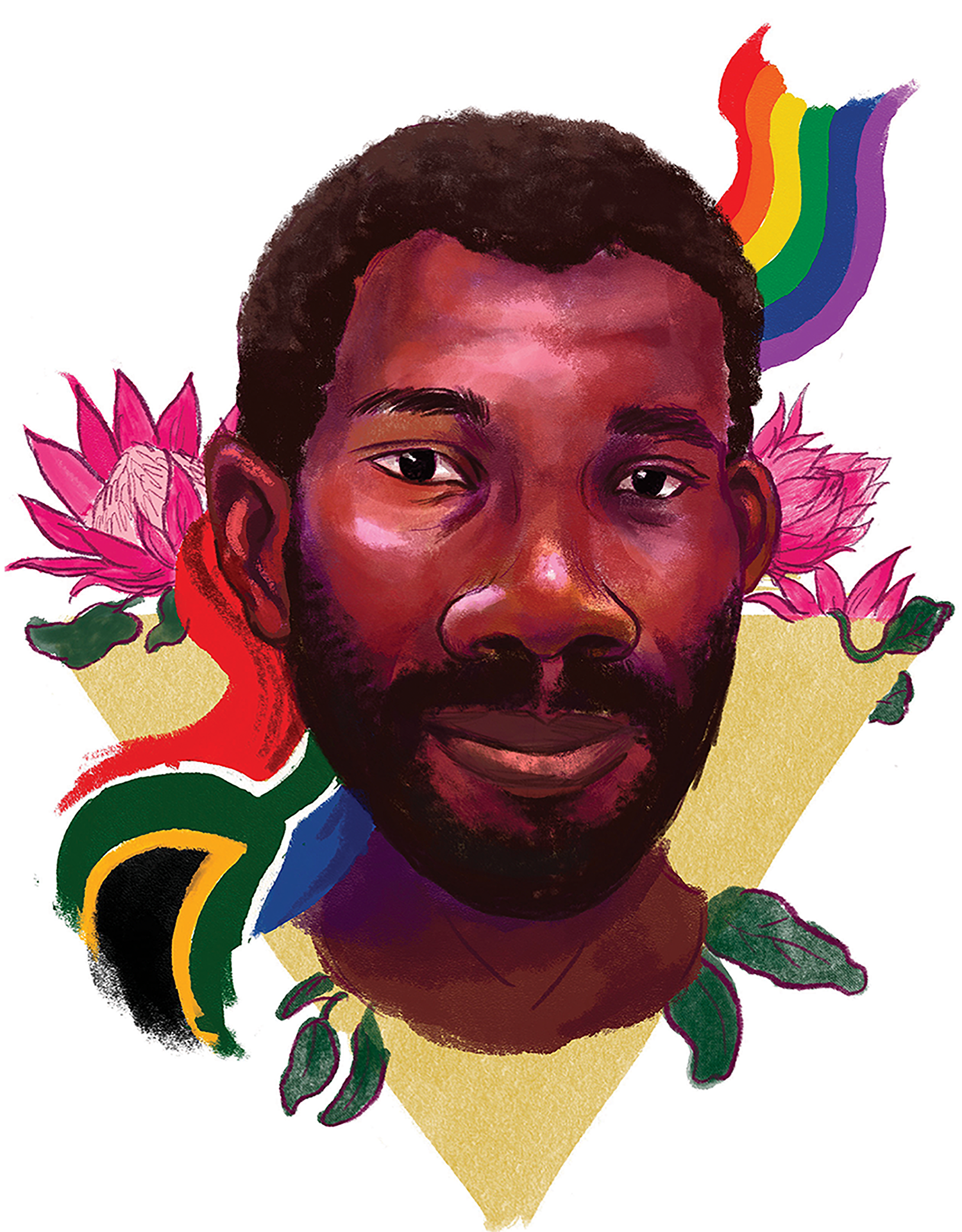
That was the experience of Simon Nkoli, a prominent Black, gay activist who spent much of his life fighting for the collective freedom of Black and gay people in apartheid South Africa.
Born in 1957 in the township of Soweto, Simon grew up in a family of six, with three siblings. Growing up, he had to navigate life in a segregated country that did not allow him many basic rights. In the process of discovering his sexual orientation, Simon met his first boyfriend, who was white. At the time, it was not safe even to be seen together. Being not only gay but also part of a mixed-race couple in pre-democracy South Africa meant their relationship was illegal in every sense.
Nkoli’s mother sought to change him, seeking help from therapists and sangomas (traditional healers), but Nkoli remained firm in his identity. She eventually came to accept him, and Nkoli later said he was “lucky” to have had a mother who tried to help in the way she knew best.
Nkoli was only young when he first became involved in activism and was arrested for the first time during the 1976 Soweto Uprising – a collection of demonstrations and protests led by black school children. He went on to attend college in Johannesburg, where he joined an anti-apartheid group called COSAS (Congress of South African Students). Once it was openly known that he was gay, the group debated whether he should be allowed to keep his position in the group. Some members even argued that being homosexual was “un-African.” He ultimately kept his position, and Nkoli never compromised his beliefs. He continued to give speeches at protests and marches against the apartheid regime, leading to him being detained on multiple occasions for his activism.
In 1983, he joined GASA (Gay Association of South Africa), a largely white gay group that occasionally supported apartheid politicians. Nkoli openly opposed these views and set out to create a new group that welcomed people of all races. By the time he was arrested again in 1984, the group had grown to 124 members but ultimately disbanded.
While imprisoned, Simon helped create a new gay and lesbian organisation, GLOW, which provided a space for people of all races and sexualities to feel seen and safe in. He also even helped open a gay bar in his hometown of Soweto. Once released, Simon gained international recognition and was invited to speak around the world. He travelled to 26 cities across Europe and North America, raising money for TAP and GLOW, speaking about apartheid, gay rights, and the AIDS crisis in South Africa. As he stated, “Freedom is what we want in this country, and that is what we are going to get!”
In 1998, Simon sadly passed away at the age of 41 due to an AIDS-related illness, after a life spent fighting for justice. He aimed to make a difference – and that is exactly what he did.
Category
Politics & Activism

.jpg)


.jpg)